
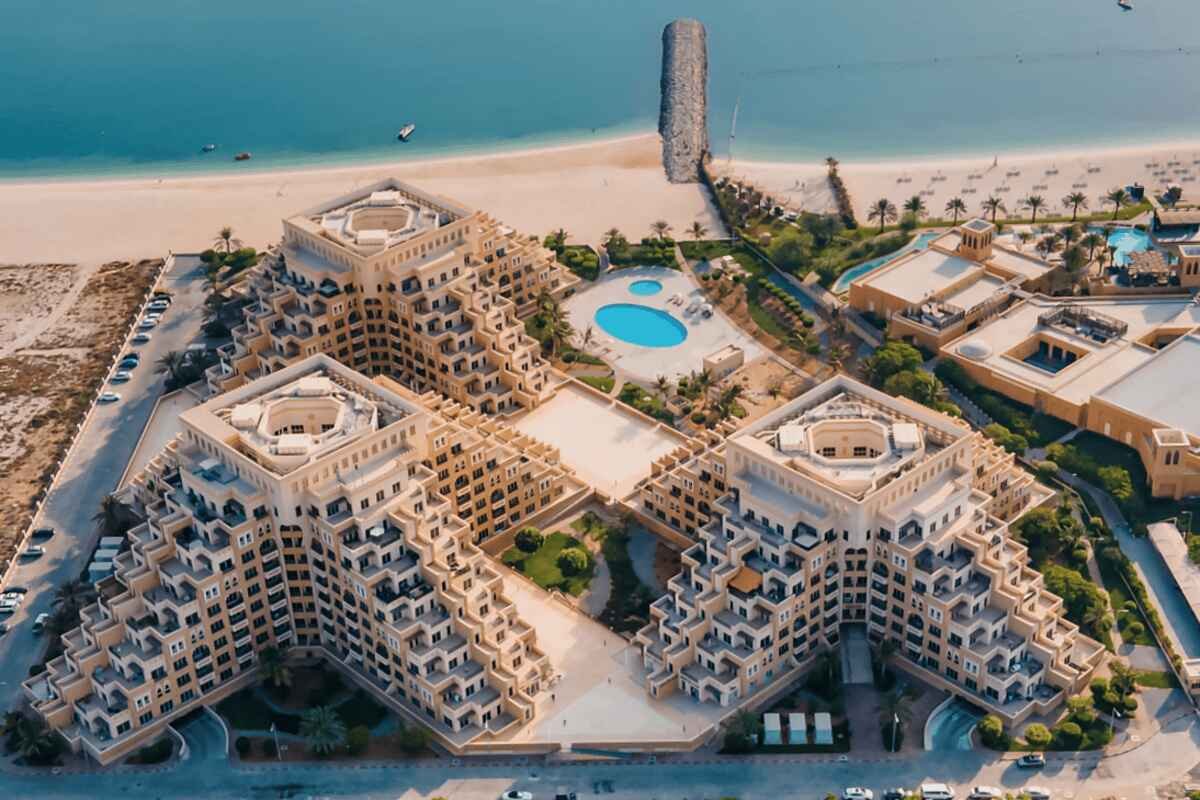
Three years ago, this comparison would have seemed like a mismatch. Dubai was the UAE property market. Ras Al Khaimah was a quiet northern emirate with beautiful coastline and modest investment volumes.
In 2026, that conversation has completely changed.
RAK apartment prices have climbed 17–21% year-on-year through 2024–2025, with Al Marjan Island recording a 21% jump in average price per square foot in early 2026 alone. The $5.1 billion Wynn Al Marjan Island resort — the UAE’s first integrated gaming destination — has topped out its 70-story tower at 283 metres and is on schedule to open in Spring 2027. New luxury brands including Mondrian, Karl Lagerfeld, and Janu (Aman’s sister brand) have all committed to the island. Over 30,000 residential units have launched in RAK since 2022.
Meanwhile, Dubai recorded AED 539.9 billion in residential transactions in 2025 — its highest ever — with 205,100 deals registered, up 18.3% year-on-year. The market is bigger, deeper, and more internationally diverse than at any point in its history.
Both markets are performing. Both have genuine investor interest. So where should you put your money in 2026?
“I cover both markets. I have clients who are right for Dubai and clients who are right for RAK. The mistake is assuming they’re the same decision.” — Neikhiil, Pro Realtor Me
The Dubai Story in 2026
Market Depth You Cannot Ignore
Dubai’s property market is one of the most liquid in the world. AED 539.9 billion in 2025 transaction value. 86% of transactions completed in cash, demonstrating that this is not a leveraged, fragile market — it is backed by genuine capital. Knight Frank has described the market’s evolution as moving “from speculative real estate to one characterised by genuine end-user demand, structural depth and long-term investor confidence.”
That liquidity matters enormously for investors. If your circumstances change, you can exit. A large, active secondary market is not something you appreciate until the moment you need it.
Cushman & Wakefield Projects 8–12% Growth in 2026
It is not just one firm. Across Cushman & Wakefield, Knight Frank, CBRE, and DLD data, the consensus for Dubai in 2026 is healthy, sustainable appreciation — not explosive, but not correcting either. Price per square foot reached AED 1,650 at mid-2025, up 6.1% year-on-year. Villa average prices crossed AED 5.2 million — a 32% annual jump in the segment.
Golden Visa Demand Driving Owner-Occupier Confidence
The UAE Golden Visa programme continues to expand. 2026 is expected to see record applications as more families convert long-term residency into property ownership. This demographic shift from renter to buyer is creating a new layer of structurally supported demand that did not exist five years ago. Buyers with Golden Visas are not speculating — they are building lives and communities in Dubai.
Al Maktoum Airport: The Decade-Long Tailwind
Al Maktoum International Airport — planned to be the world’s largest — continues to reshape Dubai South. The airport project means this corridor carries structural upside that plays out over a 10–15 year horizon, not a quarterly cycle. Off-plan in Dubai South today is, in many respects, still early-stage relative to where this submarket will be when the airport reaches operational scale.
Dubai 2026 Entry Price Reference Points
- Studio — JVC / Dubai South: AED 450,000–700,000
- 1-bed — Business Bay: AED 950,000–1,500,000
- 2-bed — Dubai Hills Estate: AED 1,600,000–2,400,000
- Villa — Dubai South: AED 1,900,000–3,200,000
- Luxury — Palm Jumeirah / Downtown: AED 3,500,000–20M+
The RAK Story in 2026
This Is No Longer a Speculative Story — It Is Structural
The Wynn Al Marjan Island resort has topped out. The 70-story tower reached its highest structural concrete point at 283 metres in December 2025. The 352-metre spire is being installed through 2026. The $2.4 billion construction facility — the largest hospitality financing transaction in UAE history — is in place. Opening: Spring 2027.
This is not a paper promise. Construction restarted at full capacity in March 2026 after a temporary pause, with new safety protocols in place. S&P Global Ratings affirmed RAK’s long-term foreign credit rating in March 2026. The project is progressing, financed, and on schedule.
What the Numbers Say
21% year-on-year jump in Al Marjan Island price per sq ft — early 2026 (Khaleej Times)
17–21% RAK apartment price growth 2024–2025 (CBRE MENA)
Up to 30% price gains in RAK villa and townhouse segment (Colliers)
6–8% average rental yield across RAK residential (Colliers 2026)
9%+ short-term rental yield in prime Al Marjan Island locations
1.36M overnight visitors to RAK in 2025 — all-time record (CBRE)
3.5M annual visitor target for RAK by 2030 (RAK Tourism Authority)
Beyond Wynn: What Else Is Happening in RAK
Wynn is the catalyst, but it is not the only story. Understanding RAK in 2026 requires looking at the full picture:
- RAK International Airport terminal expansion (30,000 sqm) increasing capacity and new routes — completion by 2028
- Air taxi routes planned between RAK and Dubai, targeting a 15-minute journey time by 2027
- Marjan and RAK Hospitality Holding merged in October 2025, creating one of the UAE’s largest master developers
- Second Wynn/Marjan joint venture announced: Janu Al Marjan Island (Aman’s sister brand) — opening 2028
- Karl Lagerfeld, Mondrian, and other international brands now committed to Al Marjan Island developments
- 19,000+ new companies registered at RAKEZ in the past year — economic base is diversifying
- RAK hotel supply exceeds 9,000 keys; 9,500 more keys planned for 2026–2030 pipeline, 92% five-star
Colliers describes RAK as having moved “from an emerging to an investment-grade market.” That transition rarely happens twice. Investors who capture it early are the ones who define the return profile.
The Pricing Reality in 2026: Still Value, But Window Is Narrowing
Gulf Business projects RAK property prices could reach AED 10,000 per square foot by 2030. Current prime Al Marjan Island pricing sits in the AED 1,500–3,500 per square foot range. That gap is the investment thesis.
However — and this is important — the rapid appreciation of 2024–2025 means the easy entry window has narrowed. Investors who bought Al Marjan off-plan in 2022–2023 are sitting on substantial paper gains. 2026 buyers are entering a market that has already re-rated. The remaining upside is real but requires a longer holding period and more selective project choice than it did three years ago.
RAK 2026 Entry Price Reference Points
- Studio — Al Marjan Island: AED 650,000–900,000
- 1-bed — Al Marjan Island (sea view): AED 900,000–1,400,000
- 2-bed — Mina Al Arab: AED 1,100,000–1,800,000
- Branded residences — Al Marjan (Mondrian / Karl Lagerfeld): AED 1,500,000–4,000,000
- Villa — RAK mainland / Al Hamra: AED 1,400,000–2,500,000
Head-to-Head: The 2026 Comparison
| Factor | Dubai | Ras Al Khaimah |
|---|---|---|
| Market Stage | Mature / Institutional | Emerging → Investment Grade |
| 2025–26 Price Growth | 8–12% forecast (C&W) | 17–21% YoY (CBRE MENA) |
| Transaction Volume | AED 539.9B (2025) | Strong; rising 2024–2025 |
| Liquidity | Very High / Easy Exit | Growing — more brands = more demand |
| Entry Price | Higher — AED 450K+ studios | Value — AED 650K+ studios |
| Gross Yield | 6–9% (established yields) | 6–9% avg; 9%+ on Al Marjan STR |
| Capital Growth | Steady, sustainable | Higher potential pre-Wynn opening |
| Catalyst | Al Maktoum Airport (long-term) | Wynn opens Spring 2027 |
| Risk Level | Low–Moderate | Moderate — more mature than 2022 |
| Best For | Stability + yield + liquidity | Growth + pre-opening positioning |
Which Market Is Right for You?
Choose Dubai if…
- You want a proven rental income stream from day one — Dubai’s tenant market is 24/7 deep
- Liquidity and a clear exit pathway matter more than maximising upside
- You are buying for personal use, relocation, or mixed use alongside investment
- You prefer established communities with full infrastructure — schools, healthcare, retail
- You are a first-time UAE buyer and want the most risk-managed entry point
- You are targeting the Al Maktoum Airport corridor as a long-horizon infrastructure play
Choose RAK if…
- You are a pure investor with a 3–5 year hold and want the highest potential return on capital
- You want to position ahead of the Spring 2027 Wynn opening — the “pre-opening squeeze” is real
- Short-term tourism rental yield in a rising hospitality market is your preferred income model
- You want genuine beachfront access at a fraction of Dubai’s per-square-foot rate
- You have researched the market and understand you are buying into an accelerating, not yet fully mature, ecosystem
- You want branded residence exposure (Mondrian, Janu, Karl Lagerfeld) at below-Dubai price points
The Third Option: Both
An increasing number of my clients in 2026 are building UAE property portfolios that span both markets. The logic is sound: a Dubai asset in JVC or Al Jaddaf provides stable yield and liquidity; a RAK position in Al Marjan provides the growth exposure and pre-Wynn upside. The two assets are not competing — they are doing different jobs for the same investor.
For investors with AED 2–4 million to allocate, a split approach is worth serious consideration.
The smartest investors I’ve worked with don’t ask “Dubai or RAK?” They ask “what is each market supposed to do for my portfolio?” When you frame it that way, the answer becomes much clearer.
What to Watch Through the Rest of 2026
Dubai
The major handover wave running through 2026–2027 will be the key variable to monitor. Communities receiving large numbers of new units simultaneously — particularly JVC and parts of Dubailand — may see rental yield softening as tenant bargaining power increases. This is manageable for informed investors, but it makes asset selection more critical than in prior years.
Luxury pricing continues to accelerate. Palm Jumeirah, Emirates Hills, and Jumeirah Bay Island have seen AED 100M+ transactions in the past year. For investors in the ultra-prime segment, 2026 may represent the last entry point before these communities reach true global destination pricing parity with Monaco and Mayfair.
RAK
All attention remains on Spring 2027. The period from now until Wynn opens is what analysts are calling the “pre-opening squeeze” — available inventory is tightening, branded launches are accelerating, and buyers seeking early positioning are competing for a shrinking pool of units. Once Wynn opens and visitor numbers surge, the demand dynamics shift again.
The RAK airport expansion completing by 2028 will be the next catalyst after Wynn — adding direct international routes and reducing dependency on Dubai International, which will be transformative for the emirate’s tourism profile and the real estate that serves it.
My View
I cover both markets daily. I see what is actually selling, what yields investors are actually achieving, and where the genuine value still sits versus where marketing has run ahead of fundamentals.
In Dubai in 2026: Dubai South and Al Jaddaf offer the most compelling combination of accessible entry price and structural long-term upside. Business Bay and Dubai Hills remain the most reliable performers for investors who prioritise consistency.
In RAK in 2026: Al Marjan Island still has runway — but you need to be selective about the developer and the specific unit. Branded residence launches from credible international operators are the tier I’d focus on. The mid-market unlabelled projects have already priced in most of the Wynn effect.
If you want to talk through the specifics — which projects, which payment plans, what the honest ROI picture looks like for your situation — that’s exactly the conversation I am here to have.